Camilo Henríquez
●
July 5, 2022
In the following lines, I share insights from my psychotherapy practice, explaining what I do and how I help people improve their mental health. This information is based on my experience of practicing psychotherapy for more than 10 years and integrates elements from multiple therapeutic models.
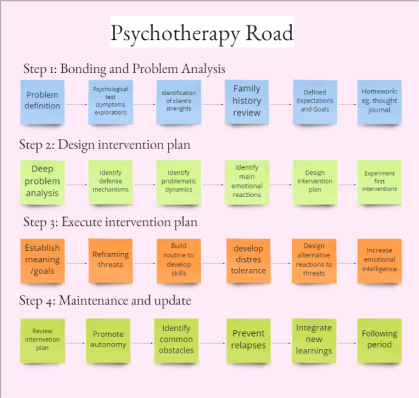
In summary, psychotherapy usually follows a structure similar to this:
I usually use a cognitive model to understand the client’s difficulties, complementing it with other approaches when necessary, depending on the client’s resources and the nature of the problem.
In short, most psychological problems are related to the client’s perception of a threat. This perception activates defense mechanisms that, paradoxically, end up impairing wellbeing.
This often looks like a struggle with a particular situation (“A”) that the client wants to be different (“B”), because situation “A” feels extremely dangerous or uncomfortable from their perspective.
Peter is experiencing problems with sleeping and socializing. He has been unable to find a job since graduating, despite trying his best (situation “A”). He would like to find a well-paid job soon and easily (situation “B”), because studying again does not appeal to him and he worked very hard to graduate.
Therefore, situation “A” triggers anxiety and insecurity, because Peter expects situation “B” to bring safety and self-worth. He interprets his current situation as personal failure: “I’m not good enough. I’m not needed.”
Although he knows intellectually that his value should not depend on his job, he cannot stop thinking that others are more competitive than him.
Assuming there are no major factors such as neurodiversity, childhood mistreatment, or trauma, this case can be framed cognitively as follows:
Peter perceives unemployment as a threat to his identity and self-worth. He may hold a core belief such as: “Jobless people are unacceptable. I am flawed and useless if I cannot work in my field.”
To cope with this belief, he struggles to accept his current reality and strongly wishes his life were different. Cognitive therapy helps Peter reflect on and update these beliefs and redefine himself.
In this first stage, building a strong therapeutic alliance is essential. This is the collaborative and trusting relationship between client and therapist.
When clients trust their therapist, they are more able to question and modify their belief system. However, this can be very challenging for clients who have experienced betrayal or neglect in the past. In such cases, building trust may take longer.
A strong therapeutic alliance increases engagement in therapy, including doing homework, attending sessions regularly, and actively participating in the process.
Through homework and several sessions, I gain a clearer understanding of how clients cope with life.
To keep things simple, most psychological difficulties can be understood as maladaptive reactions to perceived threats.
For example, in spider phobia, the threat is spiders. The defensive reaction may involve rigid avoidance strategies such as never leaving the house, keeping windows closed, using poison, or checking rooms daily.
People develop different defense mechanisms to cope with threats. In cognitive therapy, these are often called cognitive distortions or schemas.
When individuals perceive danger, they activate these defenses. This idea is influenced by stress-response theory in neuroscience and Schema Therapy, which describes three main coping styles: avoidance, compensation, and surrender.
Analyzing these patterns helps clients develop self-awareness and insight. This understanding is key for change. Often, improvement does not require more thinking, but rather learning to act in new ways.
Designing an intervention plan involves understanding how clients respond to threats and inviting them to try alternative strategies. Sometimes, this includes learning not to react and instead accepting situations as they are.
Having clarity about defense mechanisms, beliefs, and emotional responses allows clients to develop healthier ways of coping.
After practicing new perspectives and behaviors, client and therapist usually gain a clearer understanding of what is meaningful and important for the client.
As we understand ourselves psychologically, we begin to see life differently. In this sense, the world changes.
Discovering personal meaning is a powerful resource for dealing with unavoidable suffering. Life will always contain threats and pain, and meaning helps people endure even very difficult circumstances.
I often recommend the book Man’s Search for Meaning by Viktor Frankl, which describes how meaning helped him survive extreme suffering.
Once meaning and goals are clarified, we work on creating habits, rituals, reflections, and commitments that support movement in that direction.
This process combines acceptance of limitations with the development of emotional regulation and behavioral skills.
The final phase involves reviewing and updating routines and strategies.
The goal is for clients to become increasingly autonomous, learning how to reflect on their patterns and respond to difficulties independently.
This stage also focuses on relapse prevention and anticipating future challenges. Life brings both rewarding and painful experiences. Having clear tools to face difficulties and enjoy positive moments fosters peace and hope.
Follow-up sessions are often useful. They allow clients to integrate new insights and allow me to learn about long-term outcomes.
This text represents a first draft of my general approach to tele-psychotherapy or Online therapy. I also develop specific methods for different conditions and difficulties.
If you have questions or comments, feel free to share them.
Great! Please fill this short form and I will get back to you within 48 hours.